CATCH industrial Decarbonisation Network Meeting, 25th November 2026
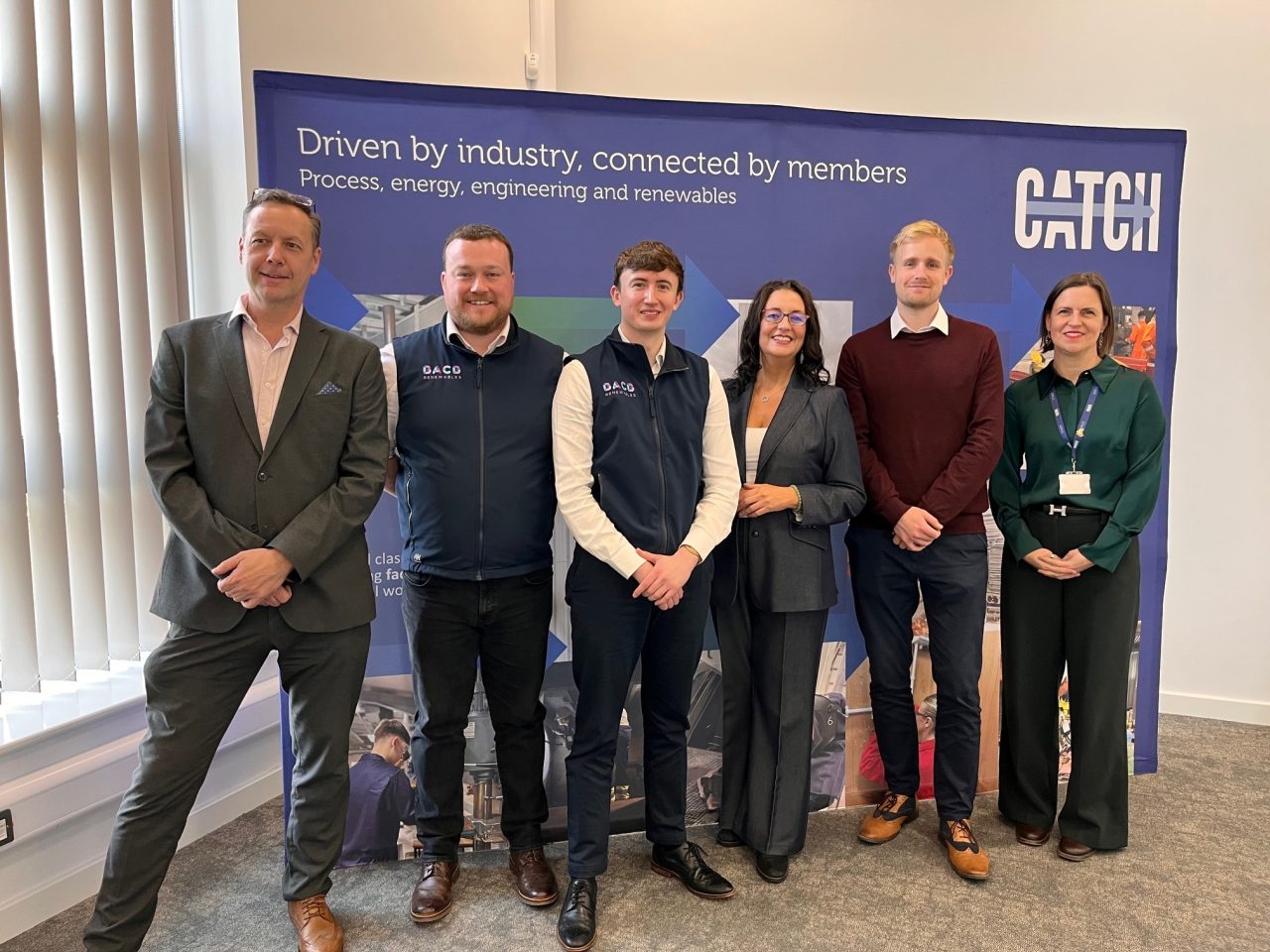
Katie Hedges, CSO, CATCH, welcomed over 40 delegates to CATCH and online for the final Industrial Decarbonisation Network for 2027! Chair Prof Joe Howe sent his apologies.
First, we welcomed speaker Tim Roff, Head of Technical Consulting and Energy Transition, United Infrastructure. Tim spoke about how they are building the infrastructure needed for UK decarbonisation. The project they are currently working on, is the Liverpool Bay CCS Ltd – Onshore Pipelines. LBCCS is the UKs first of its kind CO2 Transport and Storage project to unlock and support local industry and jobs in clean for decades to come. After a short video presentation, Tim explained in further detail the critical parts of the project such as M53 crossing and the Sealand Road compound. Finishing with details about their ESG activities and the skills investment legacy that they have made, including 500 new jobs directly on the project plus 300 in immediate supply chain.
After questions, Leo Hothersall from Jesmond Engineering, spoke about the role of Computational Fluid Dynamics (CFD) in Decarbonisation. Leo explained the link between Aerospace and decarbonisation how they are very similar. CFD is a numerical solution of the Navier-Stokes equations for the conservation of mass, momentum and energy. CFD creates value at the FEED stage, to assess and improve system design, reducing the number of design cycles needed. CFD modelling delivers flow behaviours, temperatures, particles and mixing of gasses and solids. Leo then explained how the process works for a project and what CFD is used for. Providing a specific example for Hydrogen Explosion. Leo completed his presentation with case studies, including vent line particle build up and the positive results for the client.
After a short break, Digital Twins and the Energy Market was discussed and presented by Daniel Harker & Ciaran Sharpe from BACB Renewables. First Ciaran discussed Market Content, that UK energy prices have increased 13x since 2021. Next, he covered the process of gathering data to help reduce consumption for companies, using a digital twin to model energy reduction. He explained the process of the delivery stages – site survey and data, LiDar scan to build the digital twin building including the sun path to access solar shading and PV potential. Various studies are then created from the calibrated digital twin. Ciaran then handed over to Daniel who discussed Energy market services, working with ePower to provide a combined service including renewable electricity auctions, 6 stage energy procurement process, bill validation and monthly future monitoring.
Our last speaker Julie Gallagher, On-Site Energy discussed funding the Humbers Energy Transition. Julie explained that energy costs, grid connections and policy certainty all hold projects back. For many sites, finding the capital to build them is one of the biggest barriers. Julie explained that they fund, build, own and run energy projects for energy-intensive sites. They offer a full turnkey offering, from survey and design, funding to operation and maintenance, which remains off the clients balance sheet, with no investment. The site pays a fixed, indexed rate per kWh below the grid price, over 5 to 20 years and at the end of the term the systems pass to the site and keep generating. Julie then shared various local case studies with the audience and accepted questions from the audience.
To finish, delegates enjoyed networking over lunch.
The next meeting is to be held on the 27th January 2027, with Rolls Royce SMR and Local innovation partnership fund confirmed so far.